The Discharge Nurse
Patient Education That's Easy for You, Your Team, and Your Patients.

Our Mission
To bridge the gap between what clinical teams communicate and what patients understand by creating clear, practical education that is easy for patients to use and easy for care teams to deliver.
Better Education. Better Outcomes.
Clear Communication
Help close the gap between what your clinical team explains and what your patients understand.
Increase Confidence
Give your patients practical guidance they can reference when questions come up at home.
Fewer Repeated Questions
Reinforce routine education and help reduce avoidable calls, messages, and re-explanations.
Easy for Your Team
Professionally designed education that fits into your existing discharge workflow.
Explore Our Patient Education Guides
The Numbers
80%
Of patients forget medical information after visits.
49%
Of patients accurately remember medical decisions and recommendations.
42%
Of patients report incomplete discharge instructions.
Helping Patient Succeed After Discharge
Patients often leave appointments overwhelmed and may struggle to remember important information about their care. Effective patient education reinforces key instructions, supports recovery at home, and helps patients feel more confident after discharge.The Discharge Nurse combines simple language, engaging illustrations, and practical guidance to make complex healthcare information easier to understand. Our visual patient education guides serve as an easy-to-reference resource that reinforces discharge instructions and helps patients feel informed, prepared, and supported throughout their recovery.
Patient Education Design Services
Need a guide for a procedure, diagnosis, or specialty not currently offered?
We can create visual patient education materials tailored to your organization's needs.
Read Our Latest Article
Published: October 20, 2026
Author: Patrick Miley Jr.
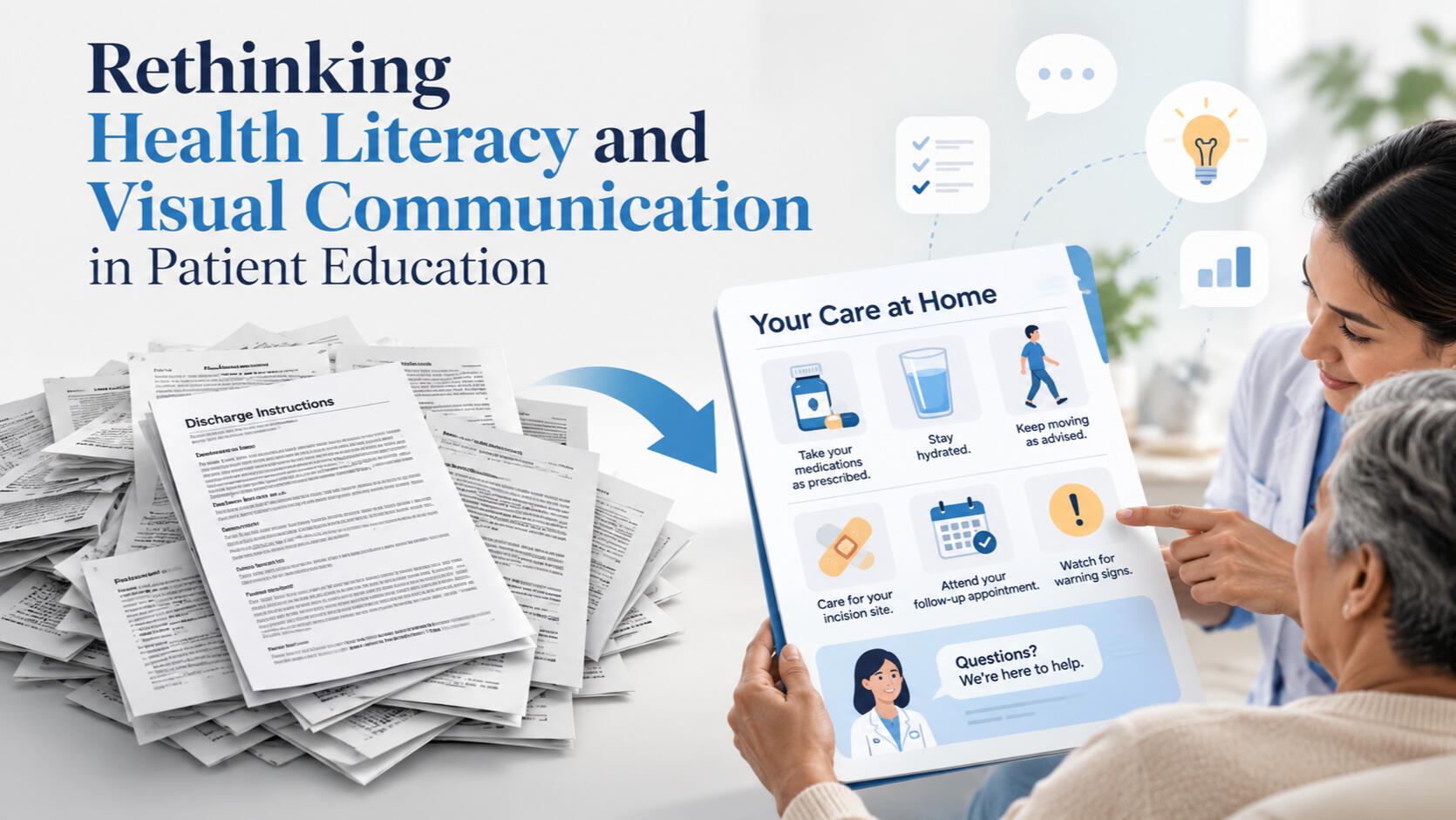
Rethinking Health Literacy and Visual Communication in Patient Education
In healthcare, we spend considerable time making patient education materials easier to read. But readability and understanding aren't necessarily the same thing.Perhaps it's time we stop focusing solely on how easy our patient education is to read and start asking how easy it is to understand and use.In our latest article, Rethinking Health Literacy and Visual Communication in Patient Education, we explore why visual communication deserves a greater role in healthcare.
© The Discharge Nurse LLC. 2026. All rights reserved.10629 Hardin Valley Rd #208, Knoxville TN, 37932
The Discharge Nurse
Contact Us
We're passionate about helping patients succeed after discharge. Whether you're interested in our guides or exploring a custom discharge education project, we're here to help!
© The Discharge Nurse LLC. 2026. All rights reserved.10629 Hardin Valley Rd #208, Knoxville TN, 37932
The Discharge Nurse
Patient Education Guides
Explore Our Catalog by Specialty
© The Discharge Nurse LLC. 2026. All rights reserved.10629 Hardin Valley Rd #208, Knoxville TN, 37932
The Discharge Nurse
About The Discharge Nurse
Our Story
Healthcare does an incredible job of diagnosing, treating, and caring for patients. But once a patient leaves the hospital, clinic, or procedure center, much of that care depends on do they understand what to do next?Patients are often discharged with pages of instructions at a time when they may already be processing a diagnosis, procedure, medication change, or new treatment plan. Important information can become buried in dense text, medical terminology, and documents that are difficult to navigate once the patient gets home.The Discharge Nurse is working to redefine patient education by bridging the gap between the information healthcare teams provide and what patients are able to understand and use.

Nurse-Founded & Led
Founded by registered nurse and educator Patrick Miley Jr., The Discharge Nurse grew from a simple observation made throughout years of clinical practice: providing information does not always mean information has been understood.The company exists to make patient education clearer, more visual, more practical, and easier to use; while making high-quality education easier for clinical teams to deliver.
Learning From Other Industries
Aviation
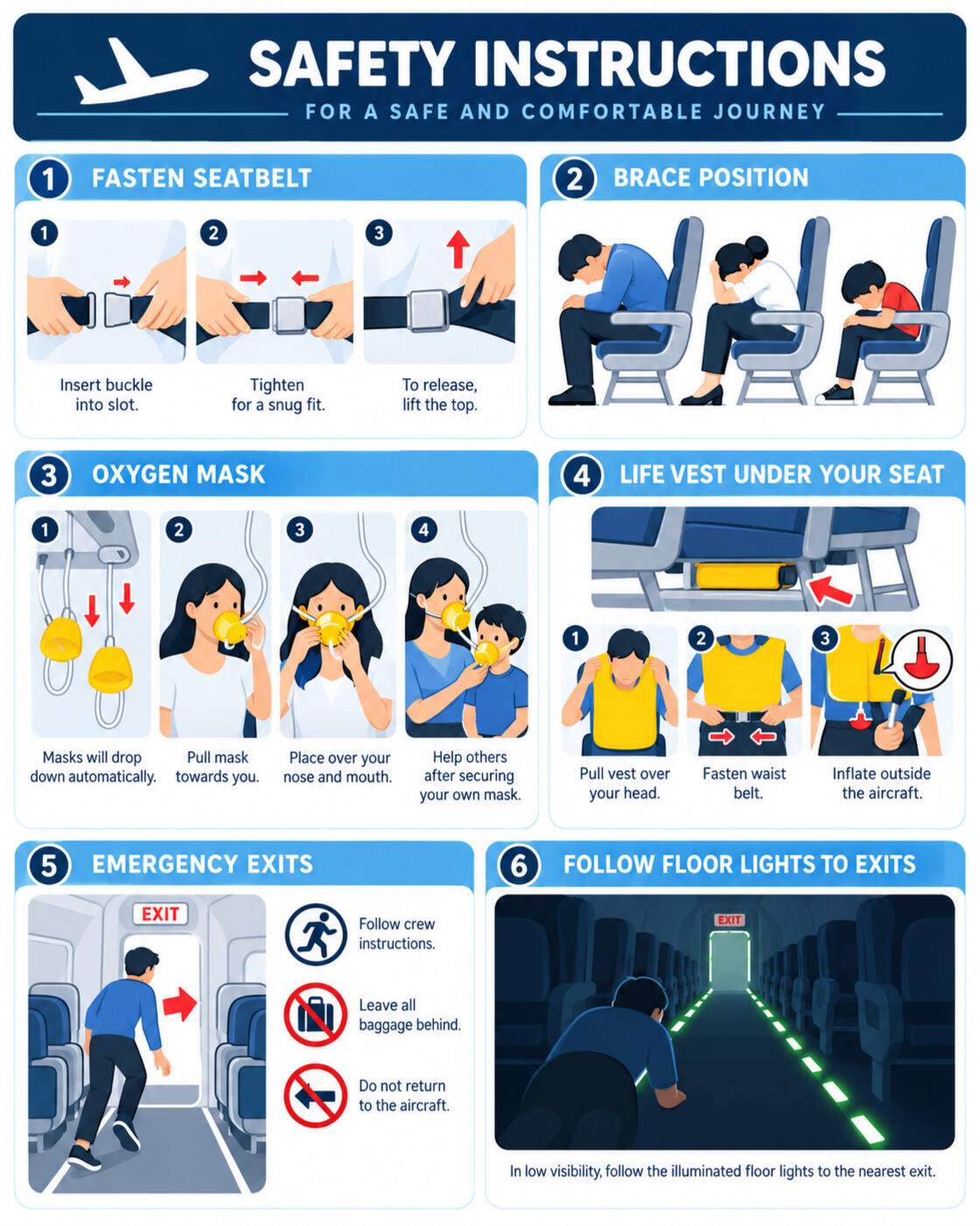
Design: Airlines do not rely on pages of dense text. Safety cards use illustrations, sequencing, symbols, color, and minimal language to communicate important actions across different languages, backgrounds, and levels of familiarity.In its 2024 guidance on passenger safety briefings and briefing cards, the Federal Aviation Administration (FAA) recommends using diagrams and illustrations to communicate safety instructions, reducing the need for written explanations wherever possible (FAA, 2024).Takeaway: When information is life-saving, visuals matter in presenting complex information.Application: Patients and caregivers are often receiving important education during moments of stress, uncertainty, or information overload. Pairing clear visuals with concise, supportive text helps make critical instructions easier to understand, easier to remember, and easier to use after discharge.
LEGO
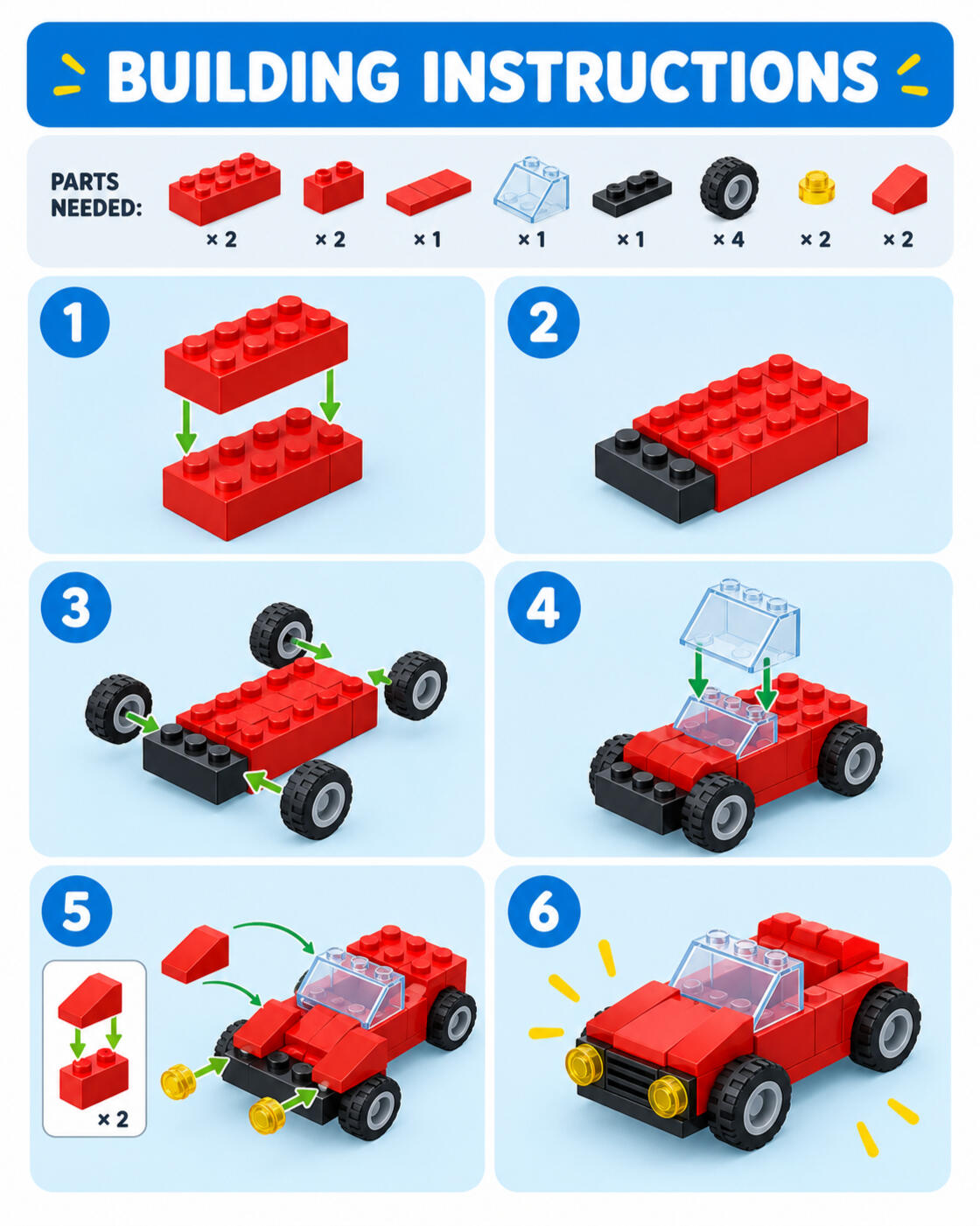
Design: A LEGO set may contain hundreds or thousands of pieces, yet the instructions can guide someone through an extremely complex build with very little written explanation. Each step is broken into a manageable action. Visuals show exactly what comes next. Complexity is introduced gradually.Takeaway: Visual instruction is not just for children. LEGO uses visual, step-by-step communication across age groups to guide people through complex tasks with minimal written explanation.Application: Healthcare instructions can feel overwhelming when patients are given too much information at once. Breaking education into clear, visual, step-by-step actions helps patients focus on what they need to do now, what comes next, and how to move through their recovery with greater confidence.
IKEA
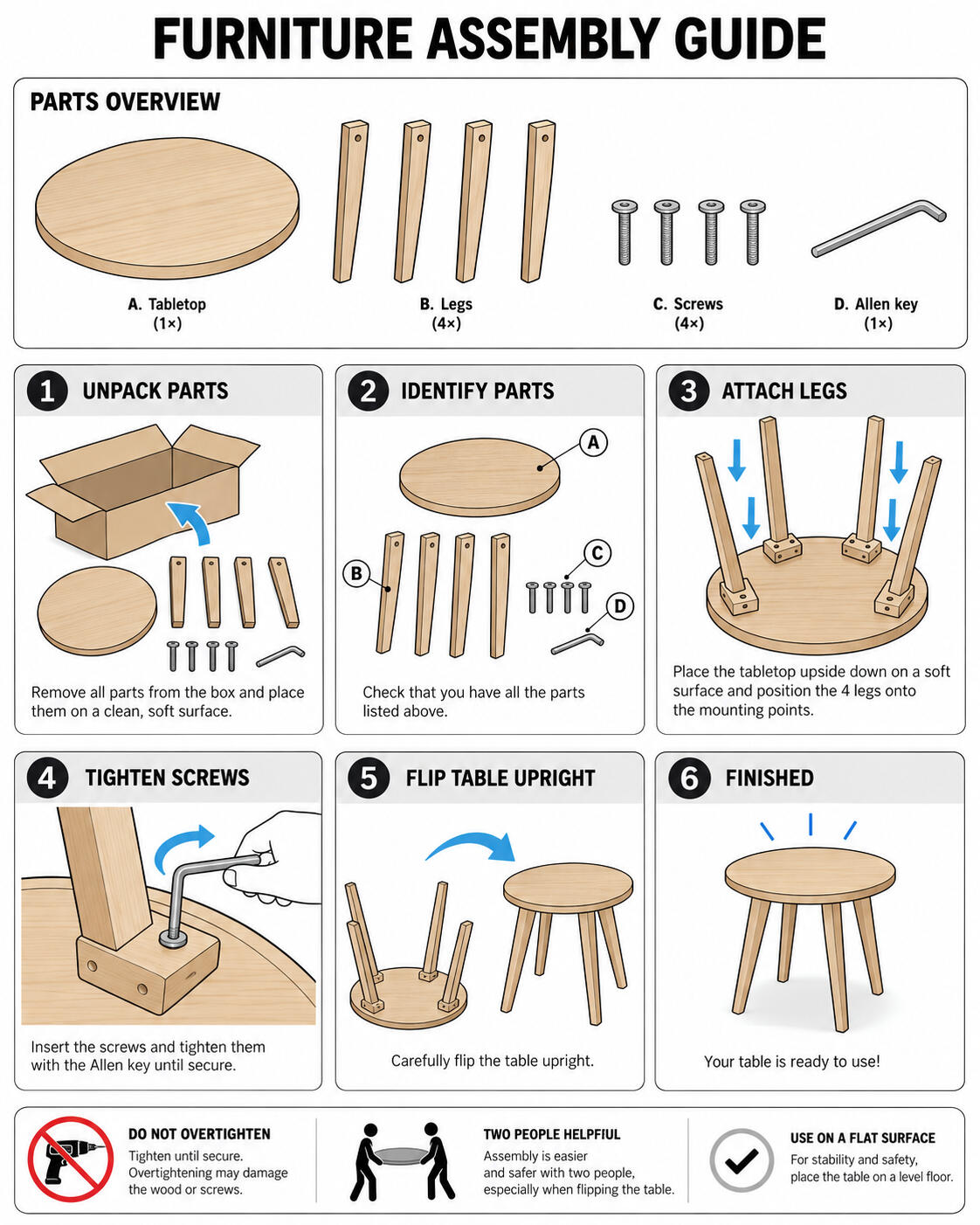
Design: IKEA has built a global business around helping people assemble unfamiliar products themselves. Its instructions rely heavily on visual communication, consistent design, simple steps, and clear sequencing.Takeaway: The customer does not need to be an expert. The instructions are designed to help them succeed.Application: The same principle should apply when a patient goes home after a procedure or receives a new diagnosis. Patients should not need a healthcare background to understand what they need to do next. Education should be designed to make unfamiliar instructions clear, practical, and easy to follow.
Bringing Visual Design to Patient Education
The Discharge Nurse brings proven principles of visual communication into healthcare to make patient education clearer, more practical, and easier to use. By combining purposeful visuals, concise language, thoughtful organization, and actionable guidance, our guides are designed to help patients better understand what comes next while making high-quality education easier for clinical teams to deliver.
© The Discharge Nurse LLC. 2026. All rights reserved.10629 Hardin Valley Rd #208, Knoxville TN, 37932
The Discharge Nurse
Dermatology Collection
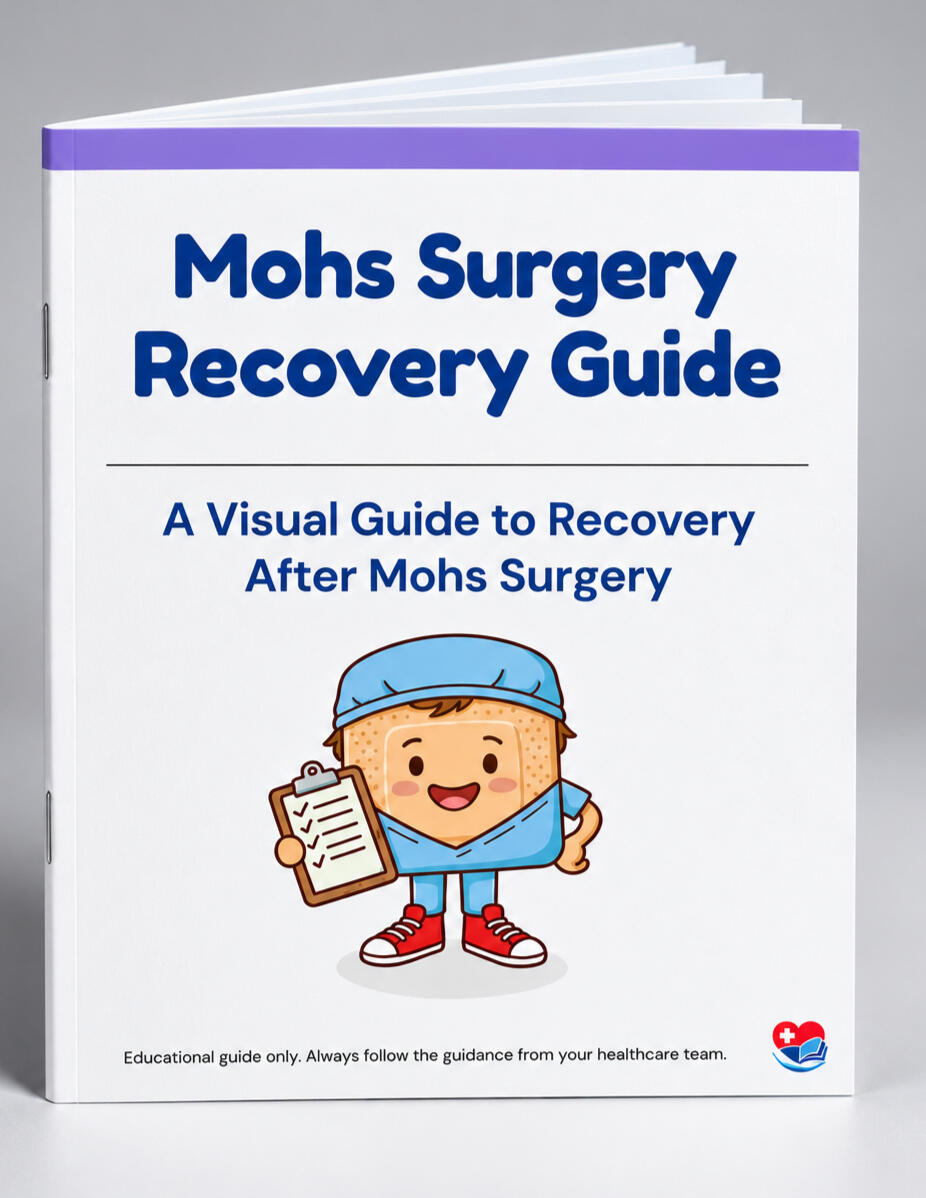
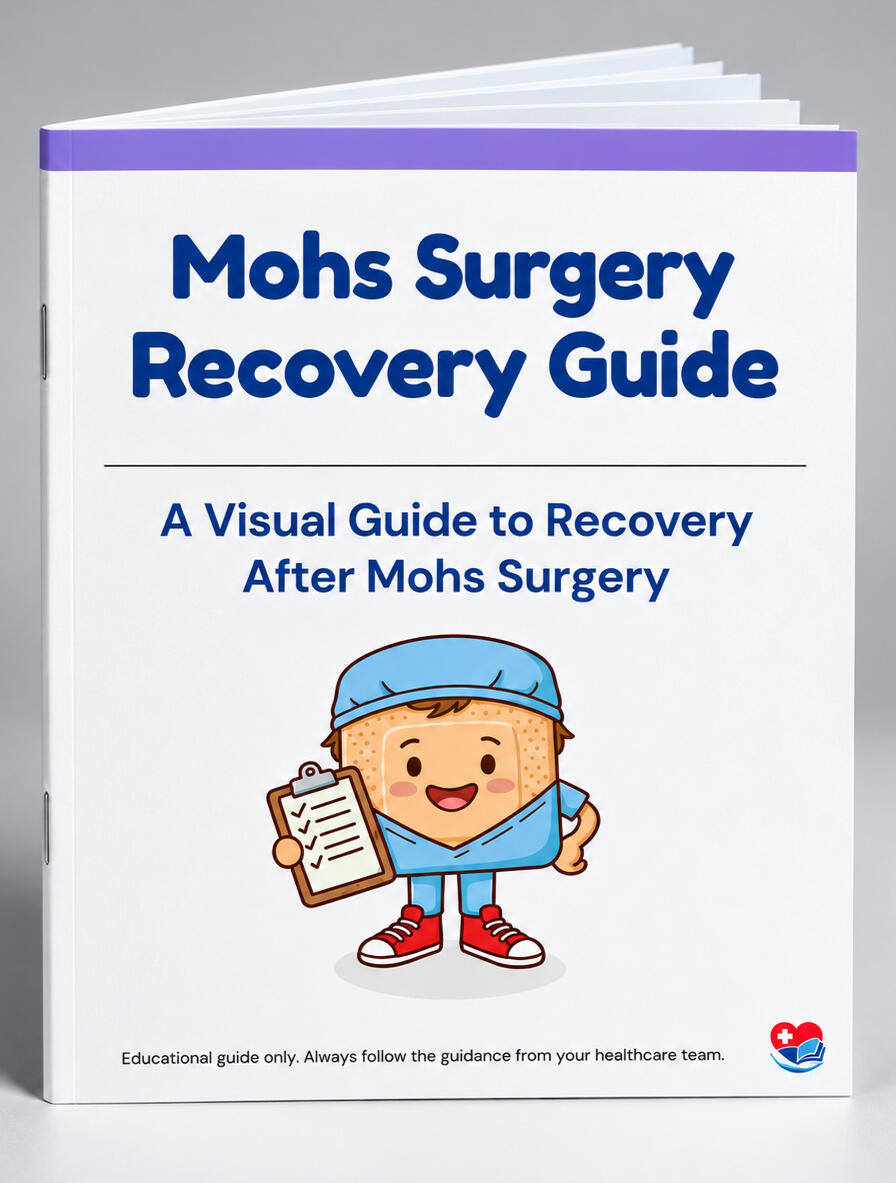
Mohs Surgery Recovery Guide
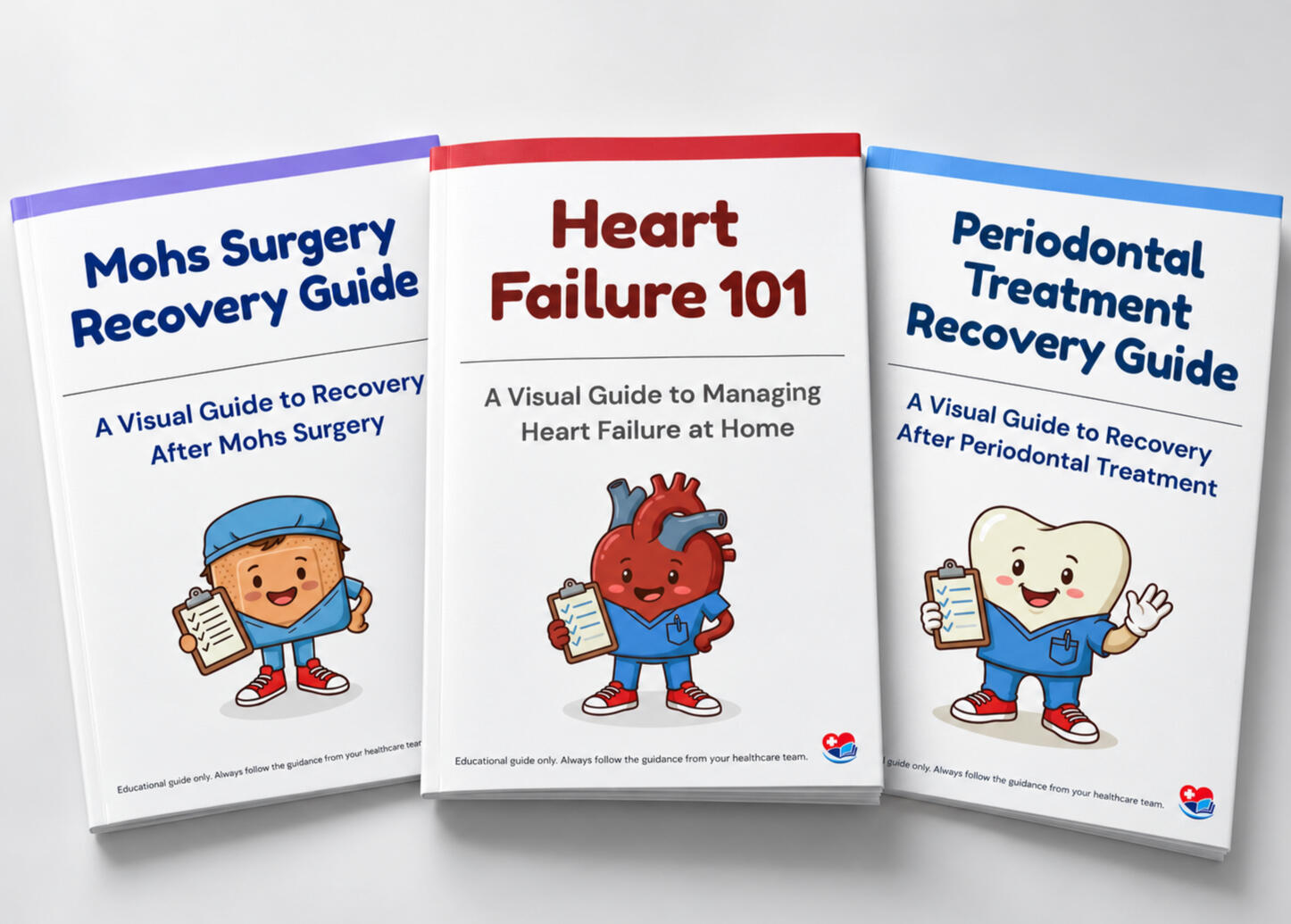
Mohs Surgery Recovery Guide is a visual patient education guide designed to help patients understand what to expect and how to care for themselves after Mohs surgery. Using simple language, clear illustrations, and practical guidance, it covers wound care, pain, bleeding, swelling, activity restrictions, signs of infection, and when to contact the care team.
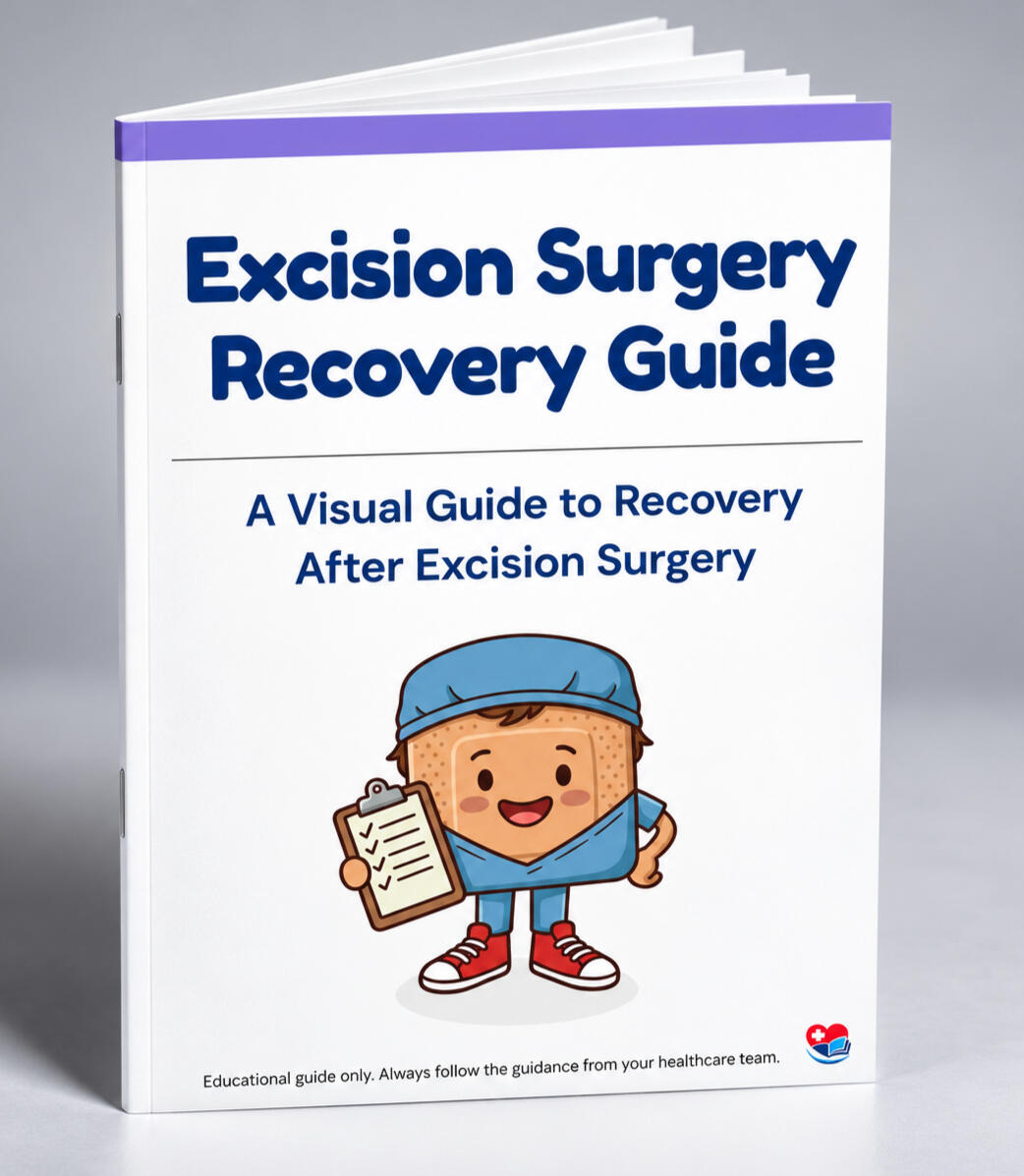
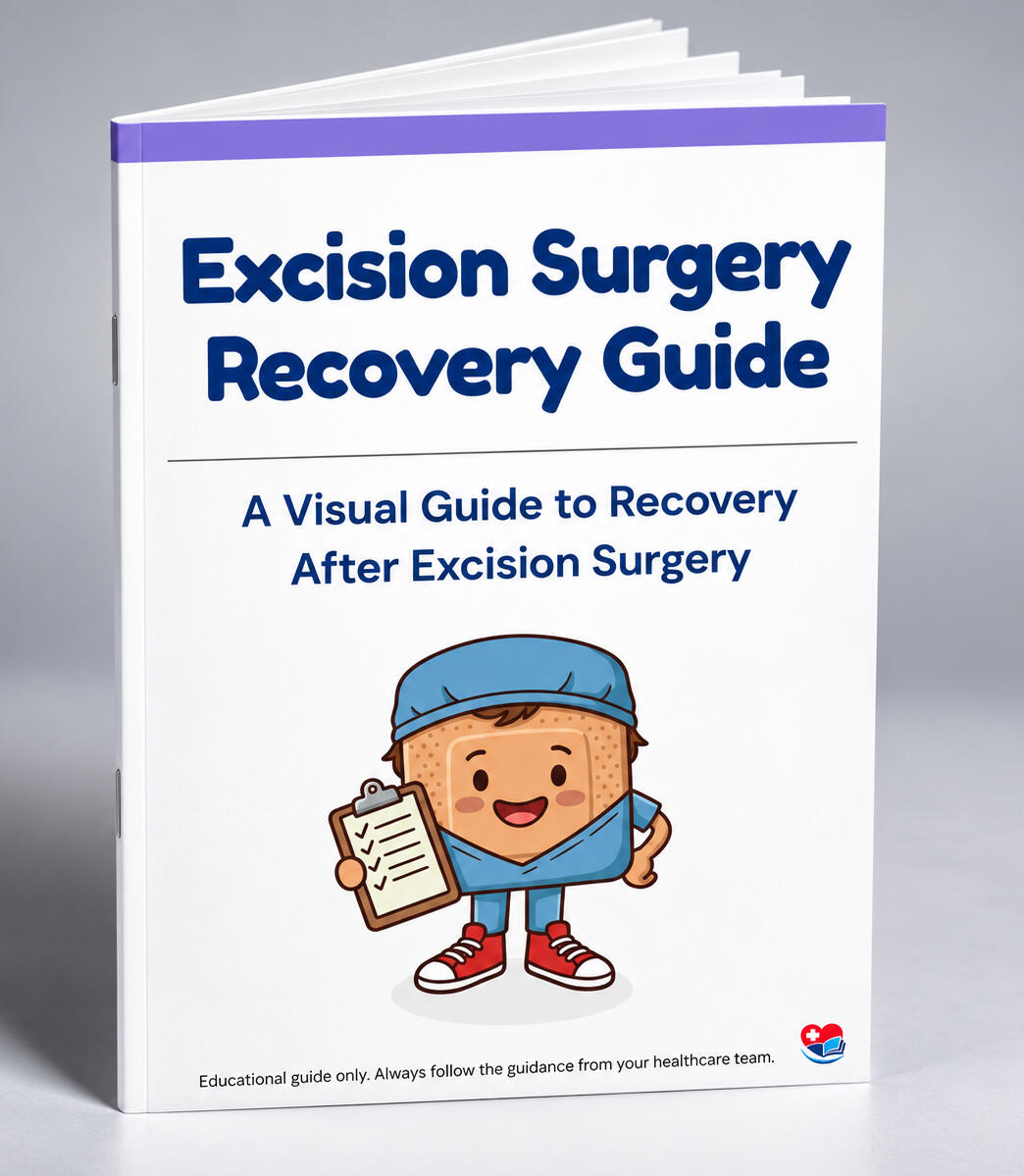
Excision Surgery Recovery Guide
Excision Surgery Recovery Guide is a visual patient education guide designed to help patients understand what to expect and how to care for themselves after Excision surgery. Using simple language, clear illustrations, and practical guidance, it covers wound care, pain, bleeding, swelling, activity restrictions, signs of infection, and when to contact the care team.
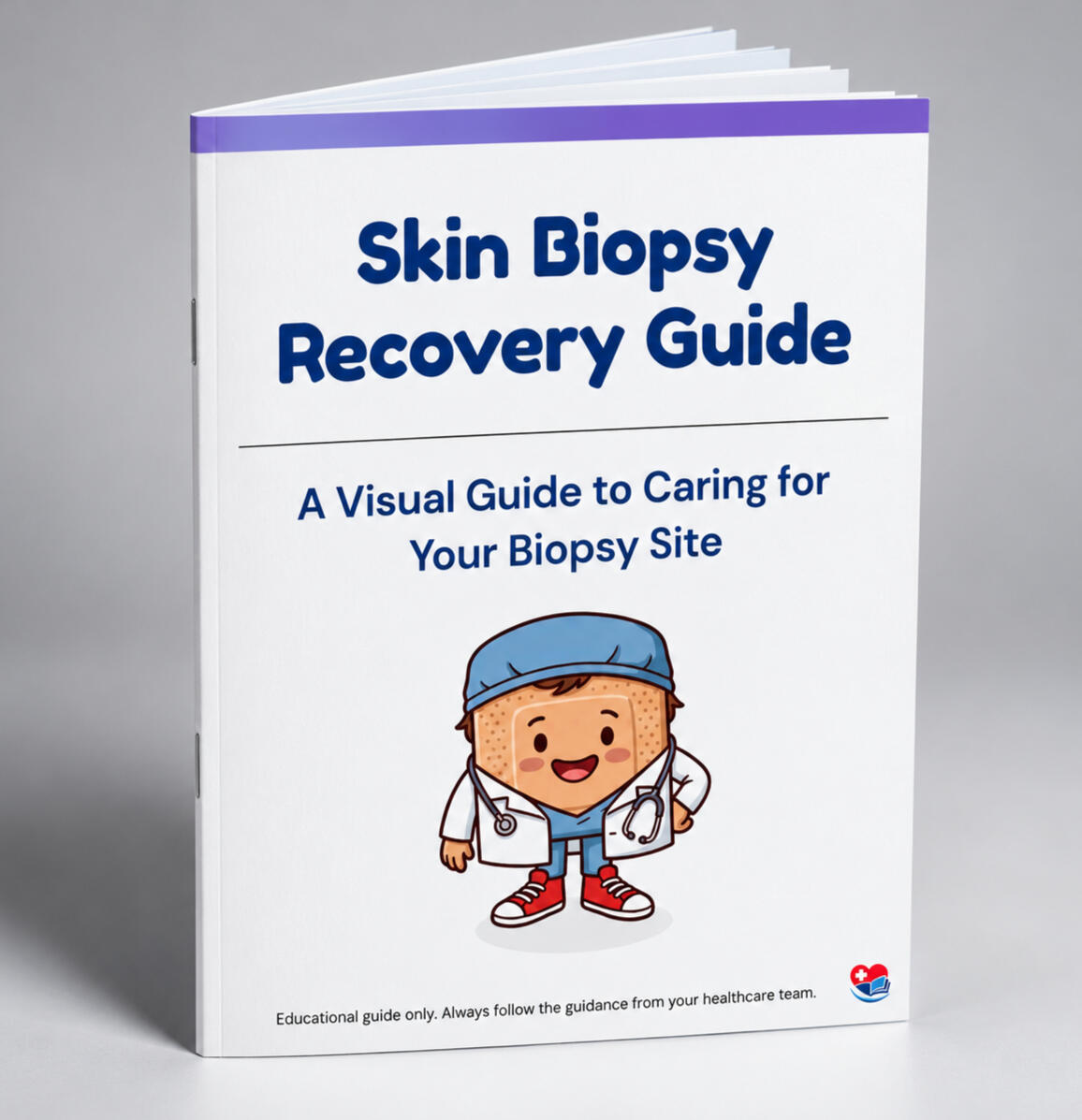
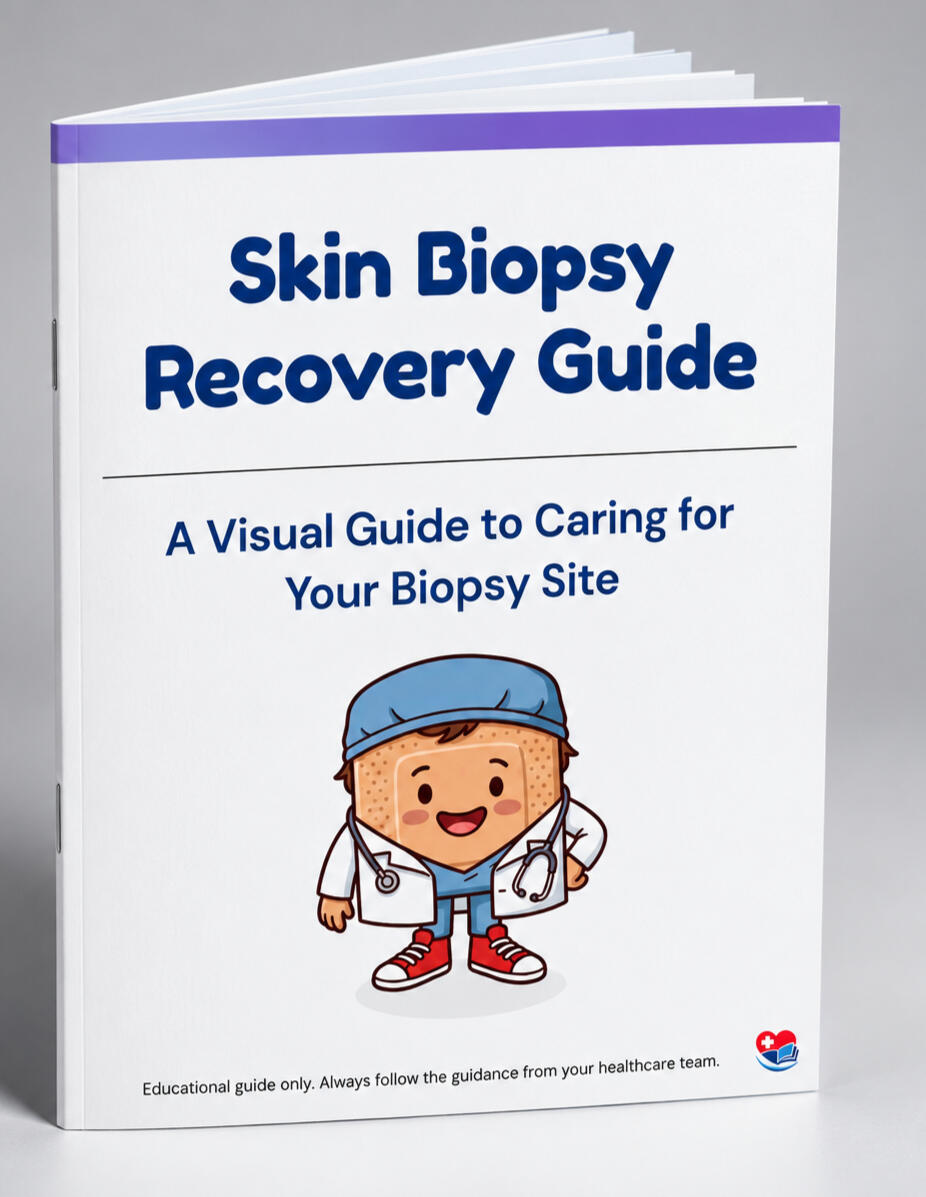
Skin Biopsy Recovery Guide
Skin Biopsy Recovery Guide is a visual patient education guide designed to help patients understand what to expect and how to care for their biopsy site after a skin biopsy. Using simple language, clear illustrations, and practical guidance, it covers healing expectations, wound care, bleeding, discomfort, activity precautions, signs of infection, biopsy results, and when to contact the care team.
Designed to be Engaging.
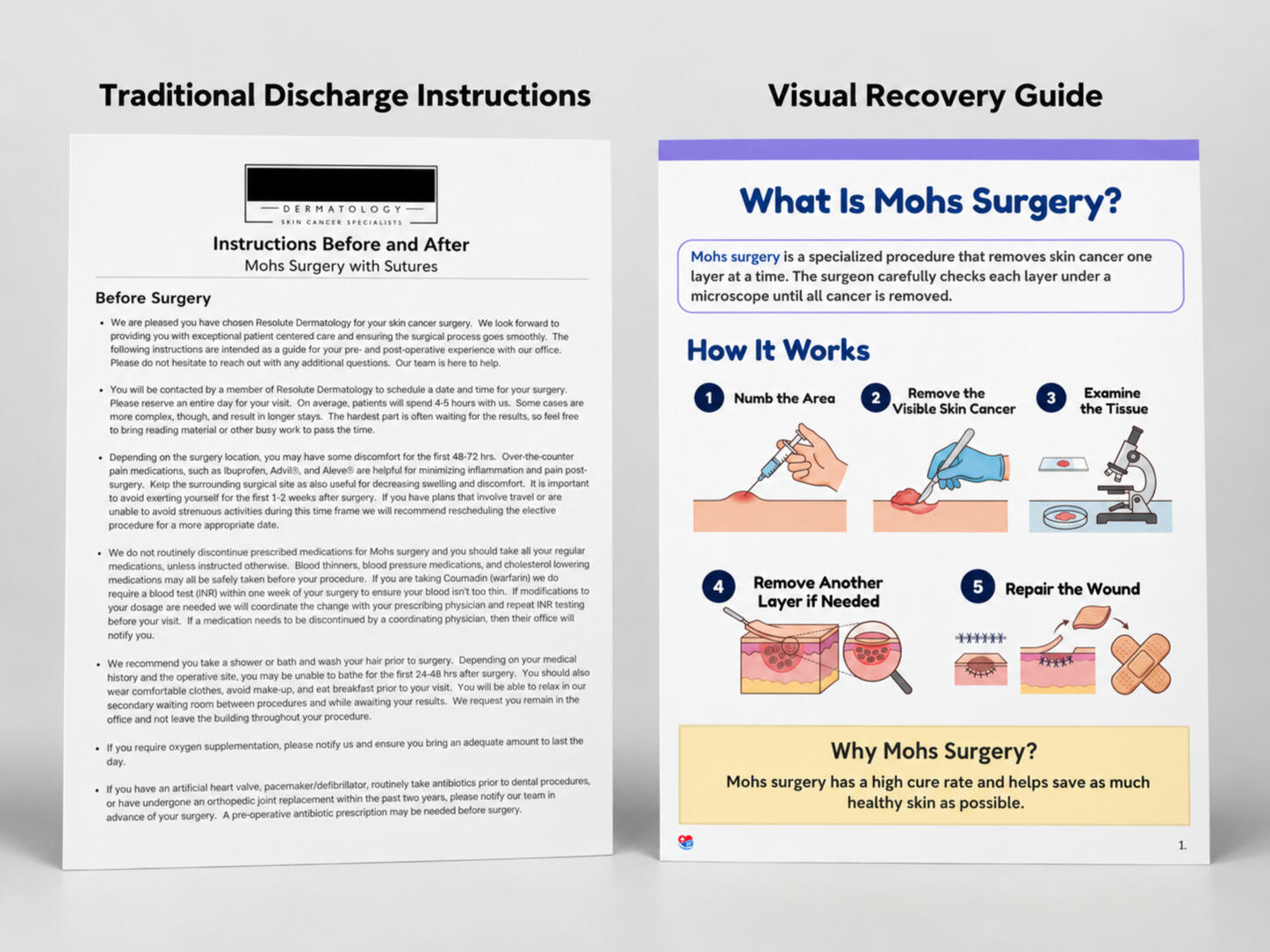
Traditional discharge instructions often rely on dense text, limited visual hierarchy, and pages of information presented at a time when patients may already be processing a new diagnosis, treatment plan, or change in their health.Our guides are intentionally different. Purposeful visuals, color, white space, clear organization, and concise text make important information easier to find and more inviting to engage with.
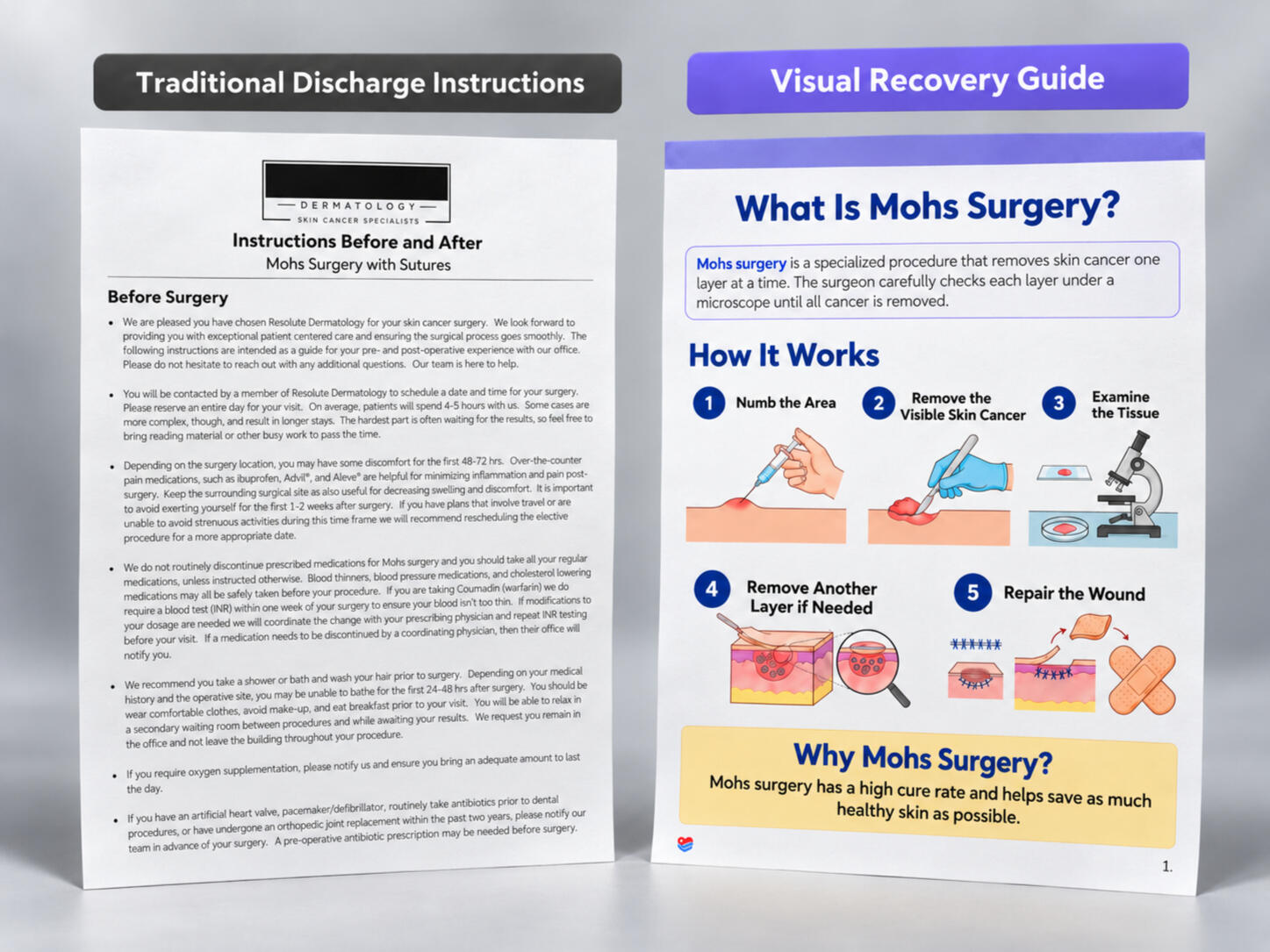
Designed to be Understood.
Providing information is only the first step. Patients need to understand what it means, remember what matters, and know how to apply it once they return home.Our guides break complex health information into clear language, manageable sections, visual explanations, and practical examples, helping patients and caregivers make sense of their care without having to navigate pages of medical terminology.
Designed to be Actionable.
Patient education should help answer the question: What do I do next?Rather than adding pictures to a traditional handout, our guides are designed around the questions patients are likely to have at home:What is happening? What should I do every day? What should I watch for? When should I call for help?Each guide reinforces the education provided by the clinical team and gives patients and caregivers a practical resource they can return to when questions arise after discharge.
Designed from Research.
Our design approach is informed by established principles of patient education and health literacy, including the Patient Education Materials Assessment Tool (PEMAT) developed by the Agency for Healthcare Research and Quality. The PEMAT evaluates whether patient education materials are both understandable and actionable.Research consistently supports the use of visual information alongside written patient education. Research specifically examining discharge instructions has also found that pictorial education can improve patient comprehension, adherence to instructions, and satisfaction (Dermody et al., 2021). In one randomized study, 65% of patients who received illustrated discharge instructions demonstrated higher comprehension, compared with 43% of patients who received text-only instructions (Austin et al., 1995).We use that evidence to design education patients can understand, and use when it matters most.
Usable
Designed to be easy to navigate, reference, and return to when questions arise at home.
Understandable
Clear language, visuals, and intentional organization help make complex health information easier to process.
Informative
Focused on the information patients need to understand to support their recovery and clear next steps.
Actionable
Clear instructions help patients identify what to do, what to watch for, and when to contact their healthcare team.
Designed using principles from AHRQ's PEMAT.
© The Discharge Nurse LLC. 2026. All rights reserved.10629 Hardin Valley Rd #208, Knoxville TN, 37932
The Discharge Nurse
Dentistry
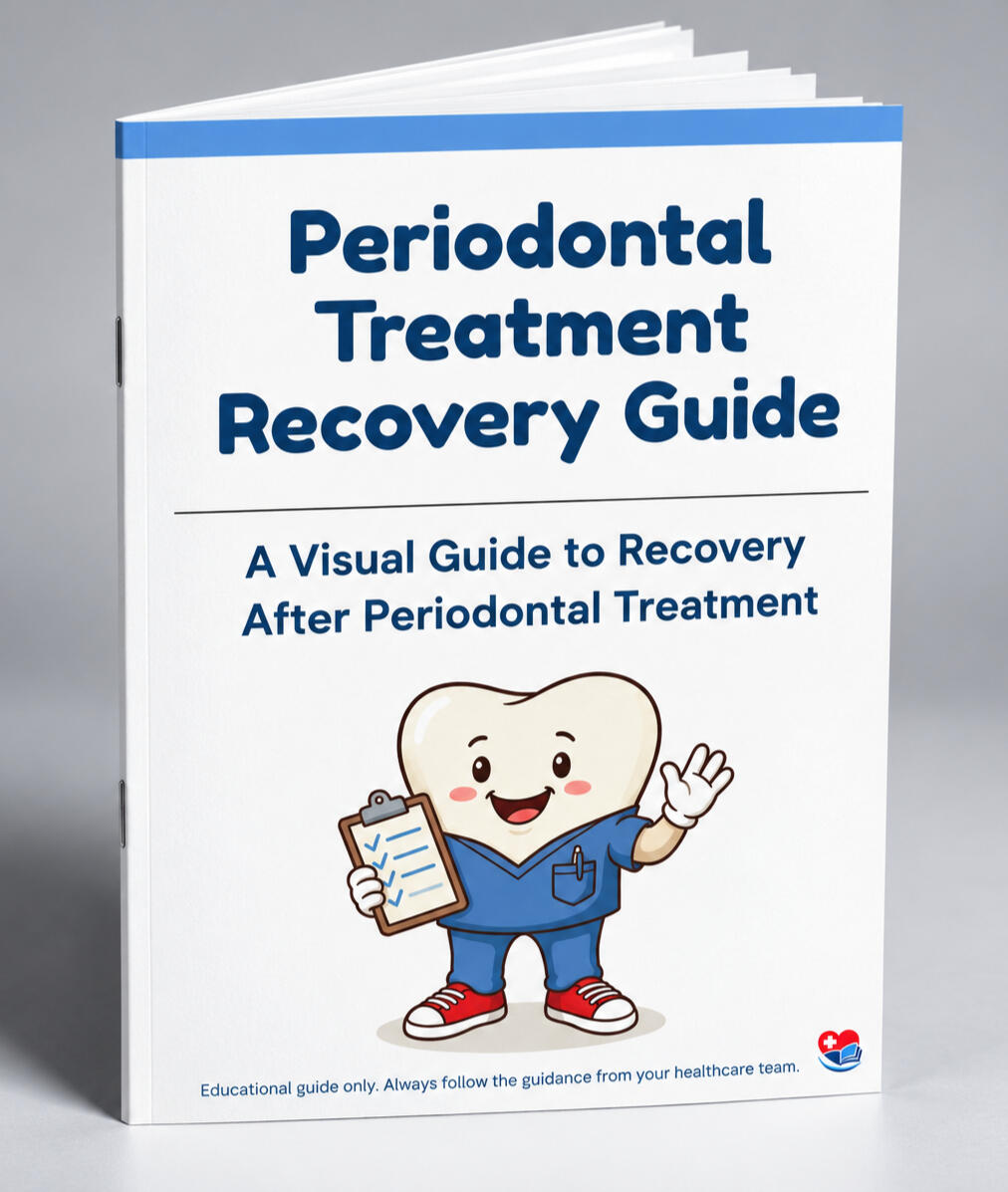
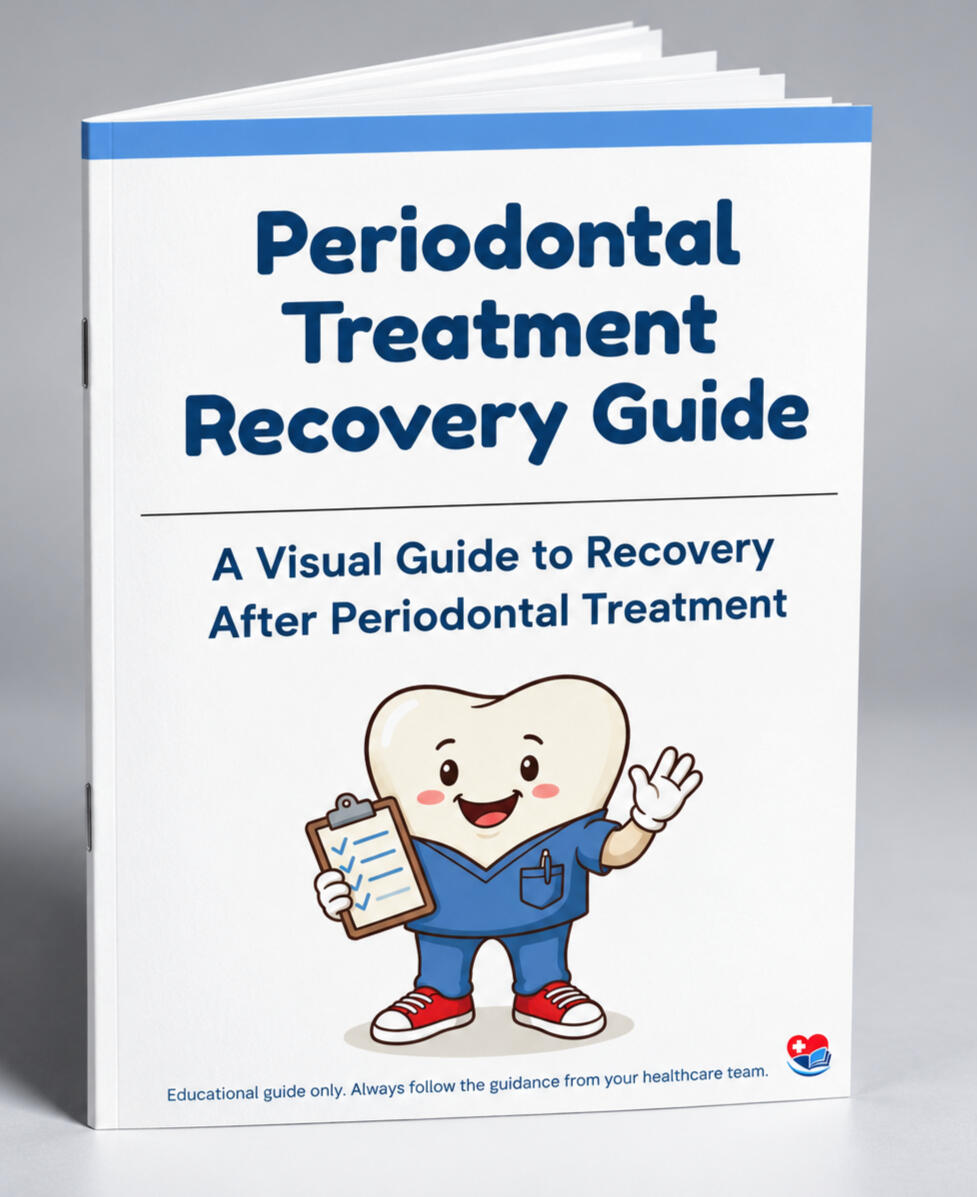
Periodontal Treatment
Periodontal Treatment Recovery Guide is a visual patient education guide that helps patients understand what to expect and aids recovery after periodontal treatment. Using simple language, clear illustrations, and practical guidance, this guide covers oral hygiene, pain management, swelling, eating and drinking recommendations, activity precautions, healing expectations, and signs of complications.
Designed to be Engaging.
Traditional discharge instructions often rely on dense text, limited visual hierarchy, and pages of information presented at a time when patients may already be processing a new diagnosis, treatment plan, or change in their health.Our guides are intentionally different. Purposeful visuals, color, white space, clear organization, and concise text make important information easier to find and more inviting to engage with.
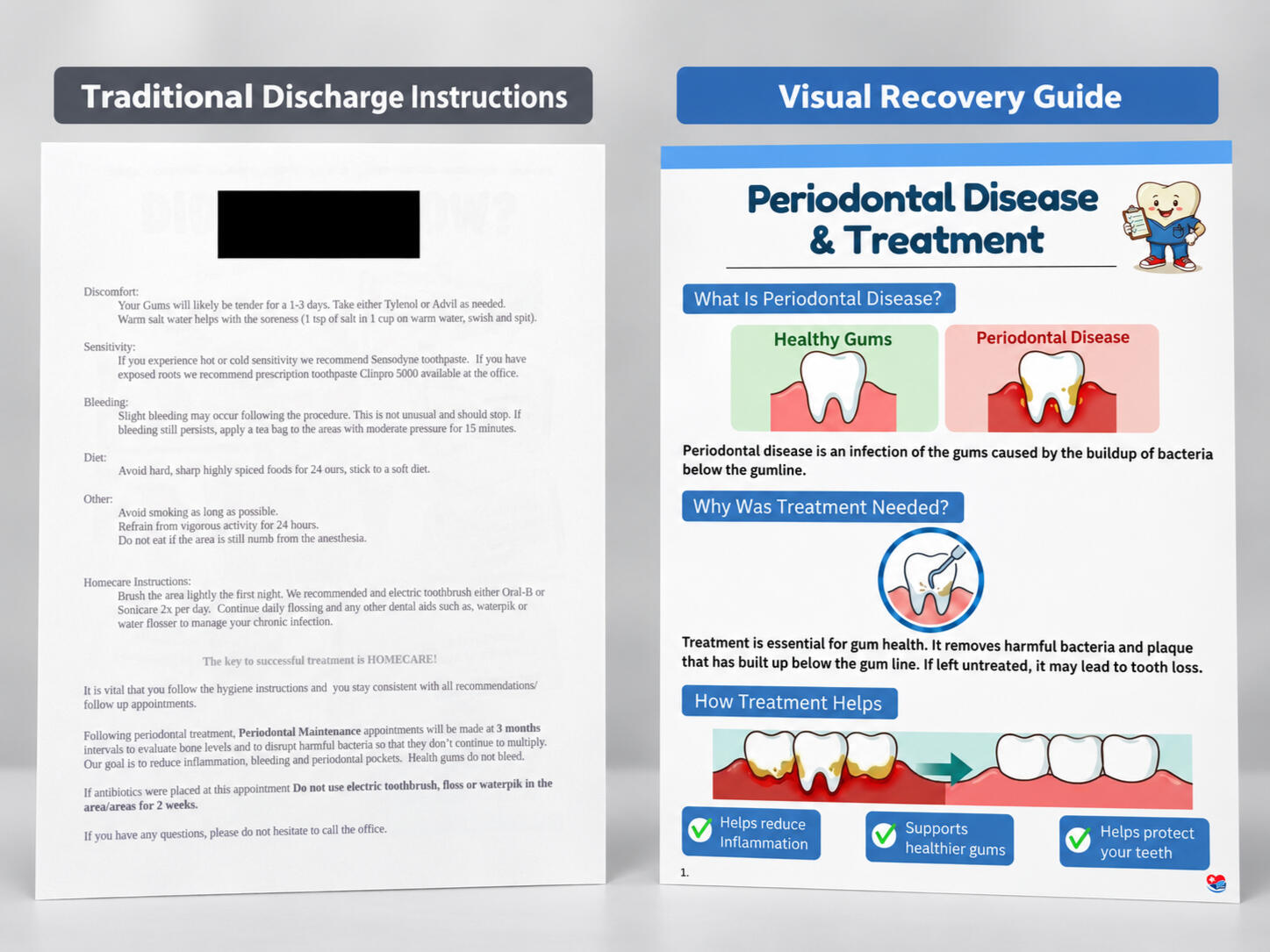
Designed to be Understood.
Providing information is only the first step. Patients need to understand what it means, remember what matters, and know how to apply it once they return home.Our guides break complex health information into clear language, manageable sections, visual explanations, and practical examples, helping patients and caregivers make sense of their care without having to navigate pages of medical terminology.
Designed to be Actionable.
Patient education should help answer the question: What do I do next?Rather than adding pictures to a traditional handout, our guides are designed around the questions patients are likely to have at home:What is happening? What should I do every day? What should I watch for? When should I call for help?Each guide reinforces the education provided by the clinical team and gives patients and caregivers a practical resource they can return to when questions arise after discharge.
Designed from Research.
Our design approach is informed by established principles of patient education and health literacy, including the Patient Education Materials Assessment Tool (PEMAT) developed by the Agency for Healthcare Research and Quality. The PEMAT evaluates whether patient education materials are both understandable and actionable.Research consistently supports the use of visual information alongside written patient education. Research specifically examining discharge instructions has also found that pictorial education can improve patient comprehension, adherence to instructions, and satisfaction (Dermody et al., 2021). In one randomized study, 65% of patients who received illustrated discharge instructions demonstrated higher comprehension, compared with 43% of patients who received text-only instructions (Austin et al., 1995).We use that evidence to design education patients can understand, and use when it matters most.
Usable
Designed to be easy to navigate, reference, and return to when questions arise at home.
Understandable
Clear language, visuals, and intentional organization help make complex health information easier to process.
Informative
Focused on the information patients need to understand to support their recovery and clear next steps.
Actionable
Clear instructions help patients identify what to do, what to watch for, and when to contact their healthcare team.
Designed using principles from AHRQ's PEMAT.
© The Discharge Nurse LLC. 2026. All rights reserved.10629 Hardin Valley Rd #208, Knoxville TN, 37932
The Discharge Nurse
Ophthalmology
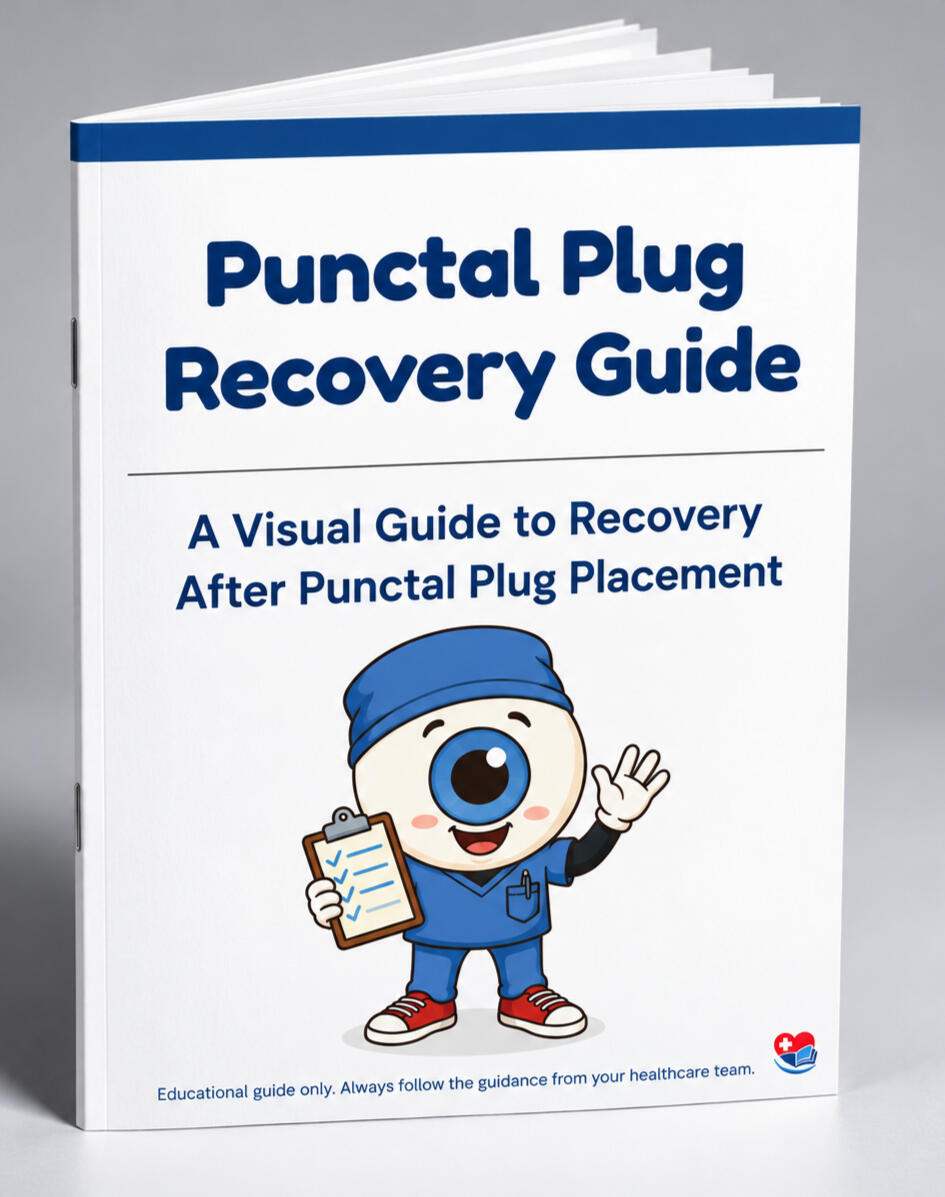
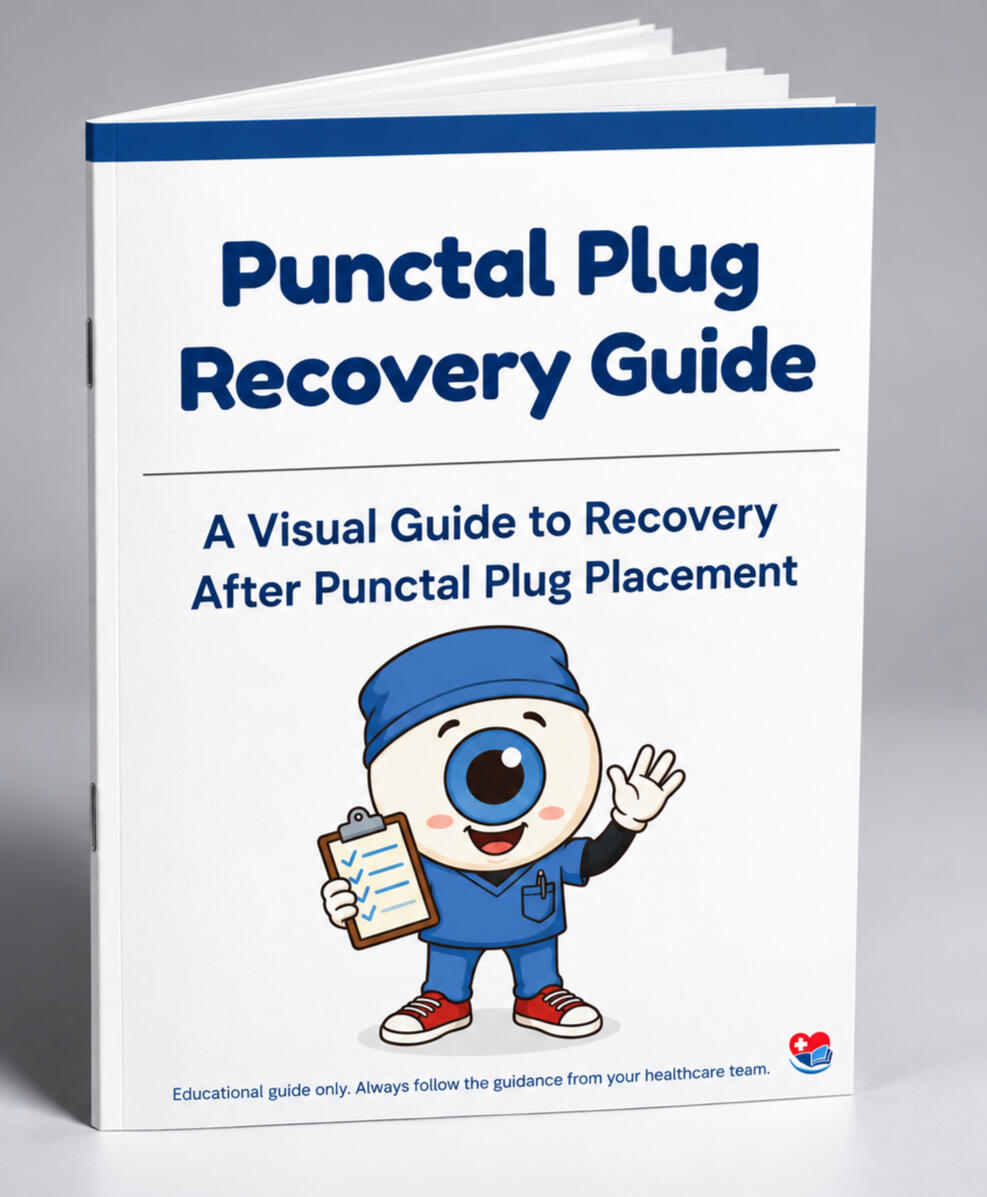
Punctal Plugs
Punctal Plug Recovery Guide is a visual patient education guide designed to help patients understand what to expect and how to care for themselves after receiving punctal plugs. Through simple language, clear illustrations, and practical guidance, this guide covers healing expectations, managing dry eye symptoms, protecting your eyes, frequently asked questions, and when to contact your healthcare provider.
Designed to be Engaging.
Traditional discharge instructions often rely on dense text, limited visual hierarchy, and pages of information presented at a time when patients may already be processing a new diagnosis, treatment plan, or change in their health.Our guides are intentionally different. Purposeful visuals, color, white space, clear organization, and concise text make important information easier to find and more inviting to engage with.
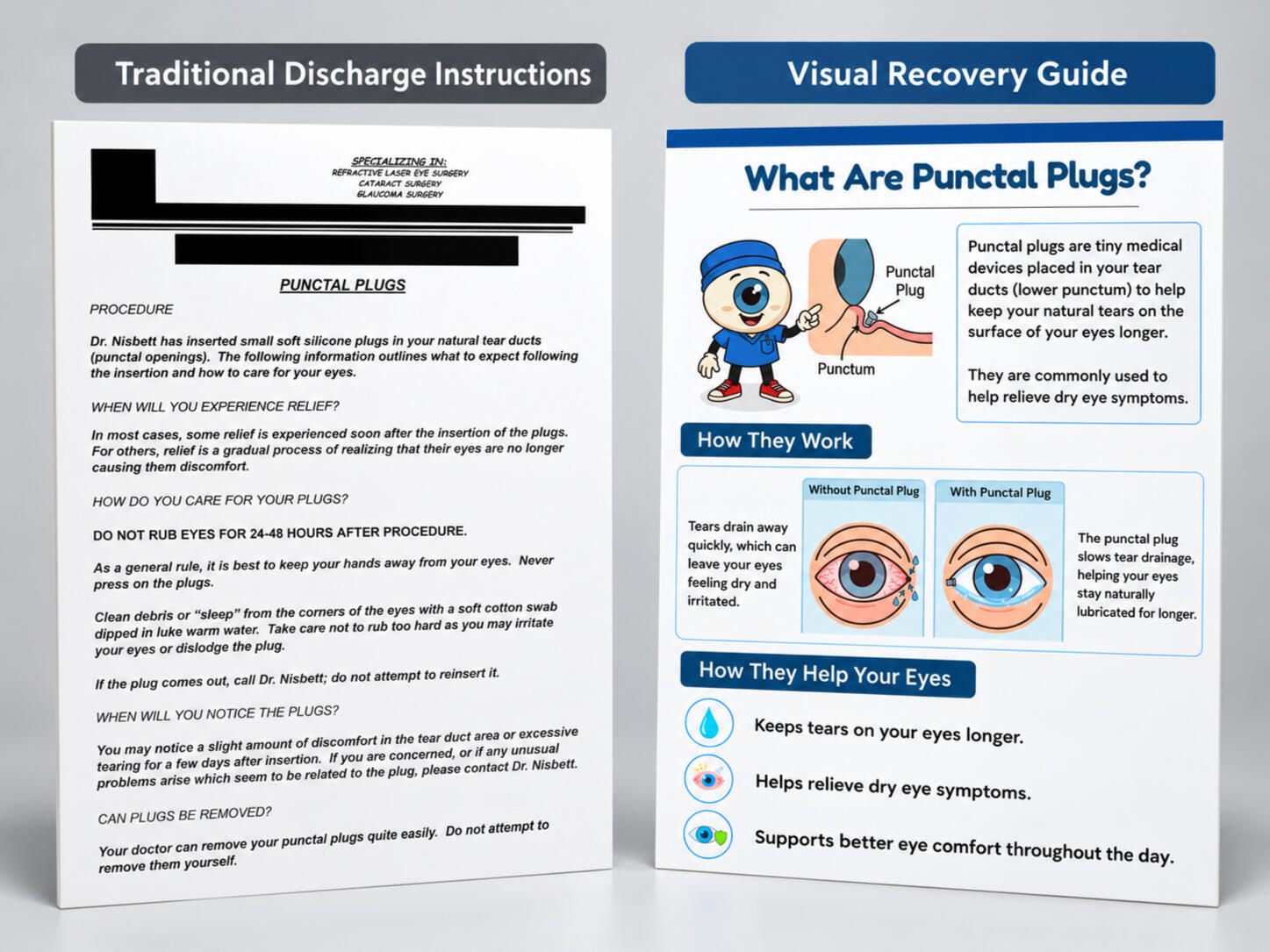
Designed to be Understood.
Providing information is only the first step. Patients need to understand what it means, remember what matters, and know how to apply it once they return home.Our guides break complex health information into clear language, manageable sections, visual explanations, and practical examples, helping patients and caregivers make sense of their care without having to navigate pages of medical terminology.
Designed to be Actionable.
Patient education should help answer the question: What do I do next?Rather than adding pictures to a traditional handout, our guides are designed around the questions patients are likely to have at home:What is happening? What should I do every day? What should I watch for? When should I call for help?Each guide reinforces the education provided by the clinical team and gives patients and caregivers a practical resource they can return to when questions arise after discharge.
Designed from Research.
Our design approach is informed by established principles of patient education and health literacy, including the Patient Education Materials Assessment Tool (PEMAT) developed by the Agency for Healthcare Research and Quality. The PEMAT evaluates whether patient education materials are both understandable and actionable.Research consistently supports the use of visual information alongside written patient education. Research specifically examining discharge instructions has also found that pictorial education can improve patient comprehension, adherence to instructions, and satisfaction (Dermody et al., 2021). In one randomized study, 65% of patients who received illustrated discharge instructions demonstrated higher comprehension, compared with 43% of patients who received text-only instructions (Austin et al., 1995).We use that evidence to design education patients can understand, and use when it matters most.
Usable
Designed to be easy to navigate, reference, and return to when questions arise at home.
Understandable
Clear language, visuals, and intentional organization help make complex health information easier to process.
Informative
Focused on the information patients need to understand to support their recovery and clear next steps.
Actionable
Clear instructions help patients identify what to do, what to watch for, and when to contact their healthcare team.
Designed using principles from AHRQ's PEMAT.
© The Discharge Nurse LLC. 2026. All rights reserved.10629 Hardin Valley Rd #208, Knoxville TN, 37932
The Discharge Nurse
Cardiology
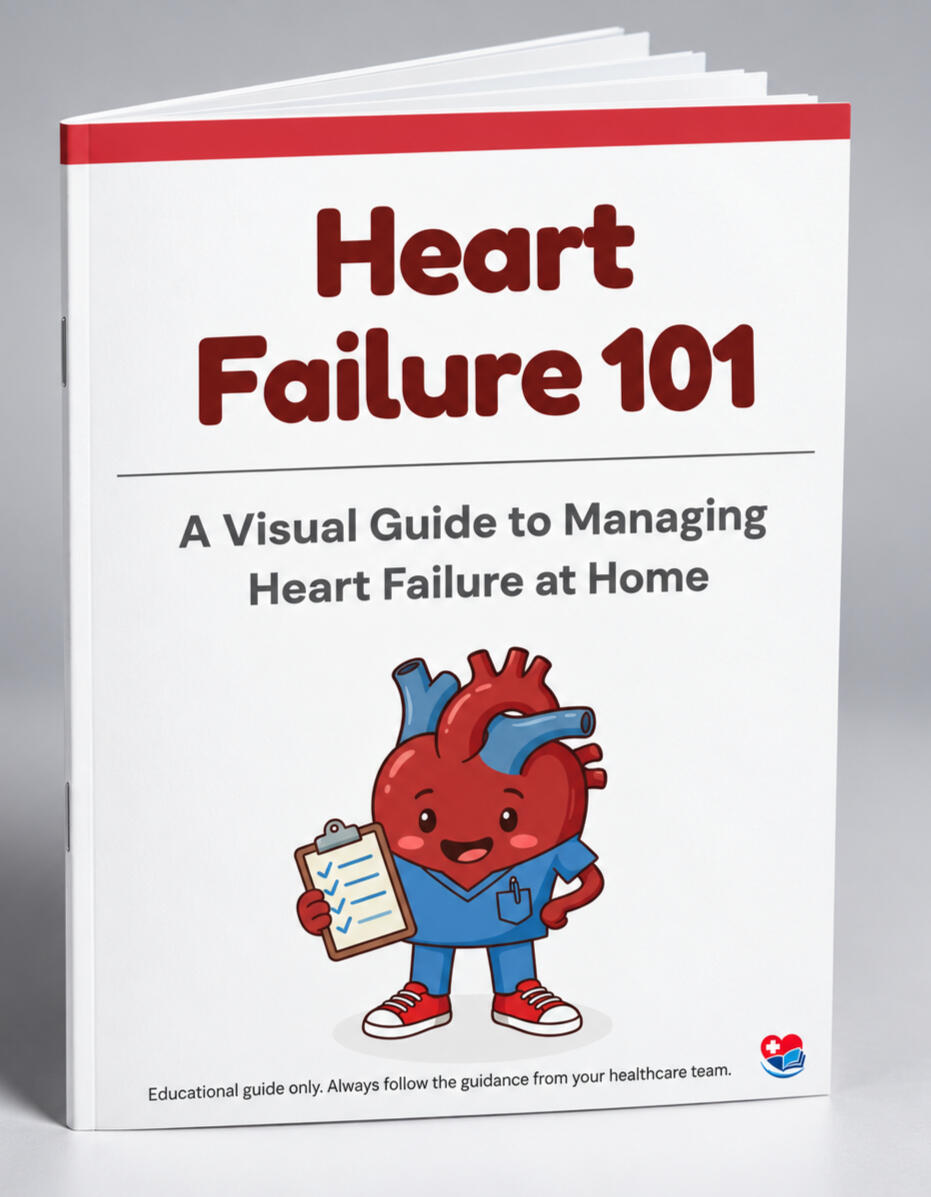
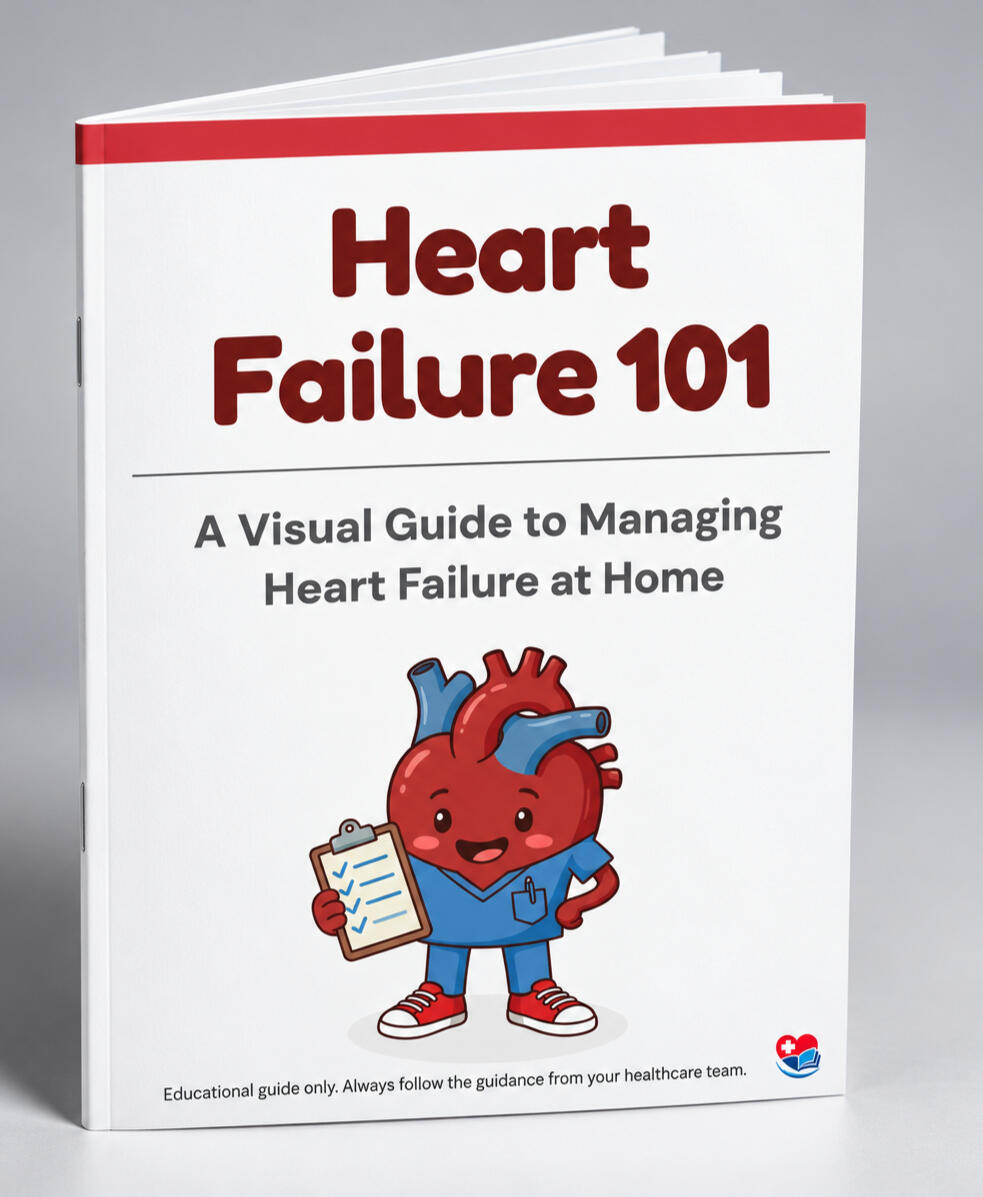
Heart Failure 101
Heart Failure 101 is a visual patient education guide designed to help patients better understand heart failure and manage their health at home. Using simple language, clear illustrations, and practical daily guidance, the guide covers symptoms, medications, nutrition, movement, weight monitoring, and when to contact the care team.
Designed to be Engaging.
Traditional discharge instructions often rely on dense text, limited visual hierarchy, and pages of information presented at a time when patients may already be processing a new diagnosis, treatment plan, or change in their health.Our guides are intentionally different. Purposeful visuals, color, white space, clear organization, and concise text make important information easier to find and more inviting to engage with.
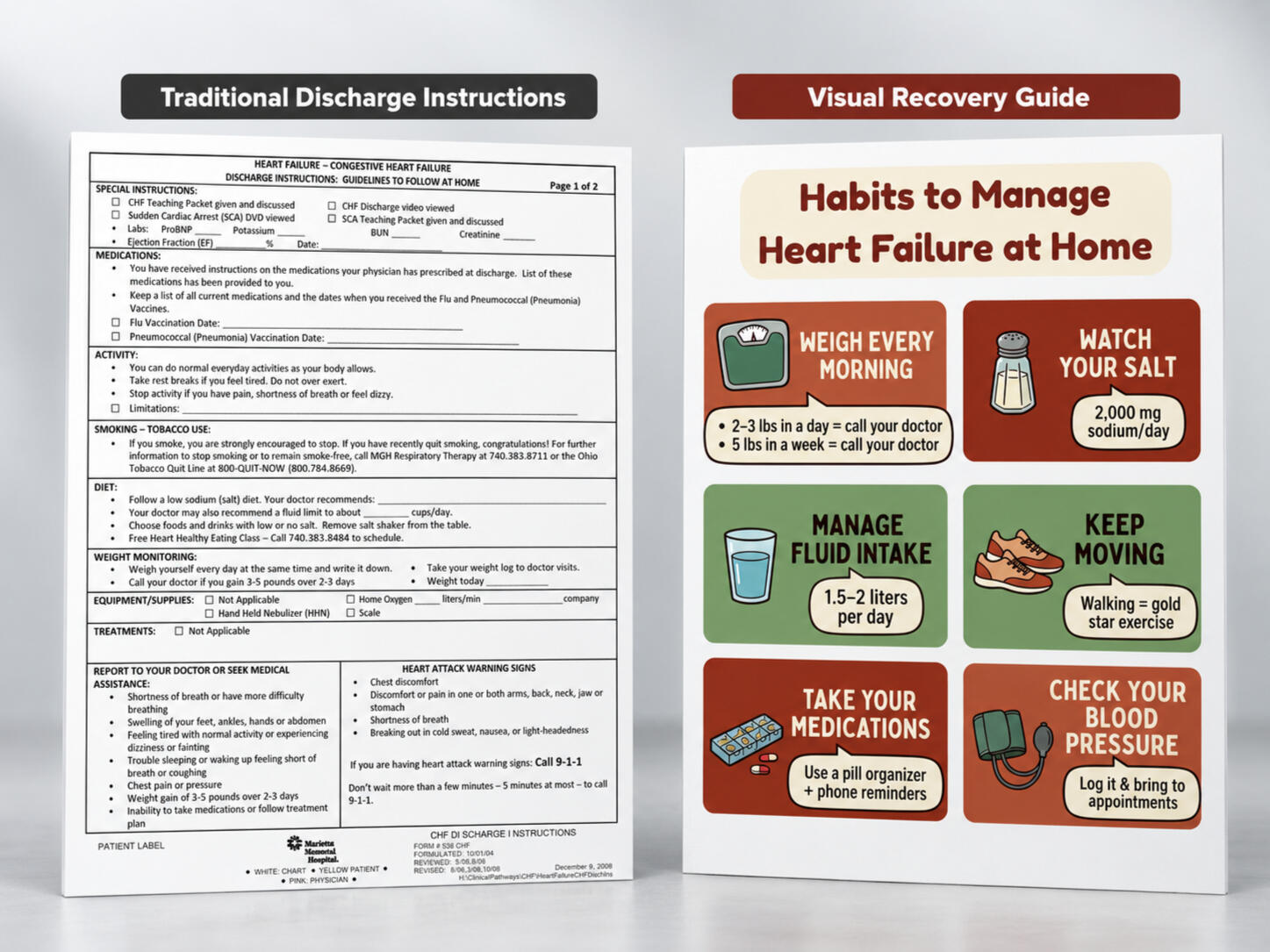
Designed to be Understood.
Providing information is only the first step. Patients need to understand what it means, remember what matters, and know how to apply it once they return home.Our guides break complex health information into clear language, manageable sections, visual explanations, and practical examples, helping patients and caregivers make sense of their care without having to navigate pages of medical terminology.
Designed to be Actionable.
Patient education should help answer the question: What do I do next?Rather than adding pictures to a traditional handout, our guides are designed around the questions patients are likely to have at home:What is happening? What should I do every day? What should I watch for? When should I call for help?Each guide reinforces the education provided by the clinical team and gives patients and caregivers a practical resource they can return to when questions arise after discharge.
Designed from Research.
Our design approach is informed by established principles of patient education and health literacy, including the Patient Education Materials Assessment Tool (PEMAT) developed by the Agency for Healthcare Research and Quality. The PEMAT evaluates whether patient education materials are both understandable and actionable.Research consistently supports the use of visual information alongside written patient education. Research specifically examining discharge instructions has also found that pictorial education can improve patient comprehension, adherence to instructions, and satisfaction (Dermody et al., 2021). In one randomized study, 65% of patients who received illustrated discharge instructions demonstrated higher comprehension, compared with 43% of patients who received text-only instructions (Austin et al., 1995).We use that evidence to design education patients can understand, and use when it matters most.
Usable
Designed to be easy to navigate, reference, and return to when questions arise at home.
Understandable
Clear language, visuals, and intentional organization help make complex health information easier to process.
Informative
Focused on the information patients need to understand to support their recovery and clear next steps.
Actionable
Clear instructions help patients identify what to do, what to watch for, and when to contact their healthcare team.
Designed using principles from AHRQ's PEMAT.
© The Discharge Nurse LLC. 2026. All rights reserved.10629 Hardin Valley Rd #208, Knoxville TN, 37932
The Discharge Nurse
We Got Your Message
Thank You!
We've received your message and will be in touch soon.
© The Discharge Nurse LLC. 2026. All rights reserved.10629 Hardin Valley Rd #208, Knoxville TN, 37932
The Discharge Nurse
Privacy Policy
Privacy Policy
The Discharge Nurse
Last Updated: July 2026
By accessing this website, you agree to the following terms:
The Discharge Nurse values your privacy. This Privacy Policy explains how information may be collected and used when you visit this website. Information collected automatically when you visit this website:
IP address
Browser type
Device information
Pages visited
Time spent on pages
Referral sources
This information is used to understand how visitors use the site and to improve the educational experience.
Cookies and Analytics
This website may use cookies or analytics tools to understand general visitor behavior. These tools help improve site performance and content quality.
Examples may include analytics platforms or embedded tools.
Third-Party Services
This website may link to or integrate with third-party platforms. These services may collect information according to their own privacy policies. The Discharge Nurse does not control how third-party services handle data.
Personal Health Information
The Discharge Nurse website does not collect personal health information through this website.
Services Agreement
If you choose to work with The Discharge Nurse, separate agreements and policies may apply.
Contact
If you have questions about this policy, you may contact:
The Discharge Nurse, LLC.
Email: [email protected]
Address: 10629 Hardin Valley Rd #208, Knoxville TN 37932
© The Discharge Nurse LLC. 2026. All rights reserved.10629 Hardin Valley Rd #208, Knoxville TN, 37932
The Discharge Nurse
Terms of Use
Terms of Use
The Discharge Nurse
Last Updated: July 2026
By accessing this website, you agree to the following terms:
Education Purpose
All content provided on this website is for educational and informational purposes only. Not Medical Advice. The information provided on this website is not intended to replace professional medical advice, diagnosis, or treatment. Always seek the advice of your physician or other qualified healthcare provider regarding any medical condition. Do not disregard professional medical advice because of information found on this website.
No Doctor-Patient Relationship
Use of this website does not create a doctor-patient, nurse-patient, or healthcare provider relationship.
Limitation of Liability
The Discharge Nurse makes reasonable efforts to provide accurate information. However, health information is constantly evolving. The Discharge Nurse is not responsible for any actions taken based on the information provided on this website. Use of the website and its content is at your own discretion and risk.
Intellectual Property
All materials on this website, including text, graphics, and educational materials, are the property of The Discharge Nurse unless otherwise stated.
These materials may not be copied, reproduced, or distributed without permission.
Contact
If you have questions about this policy, you may contact:
The Discharge Nurse, LLC.
Email: [email protected]
Address: 10629 Hardin Valley Rd #208, Knoxville TN 37932
© The Discharge Nurse LLC. 2026. All rights reserved.10629 Hardin Valley Rd #208, Knoxville TN, 37932
The Discharge Nurse
Medical Disclaimer
Medical Disclaimer
The Discharge Nurse
Last Updated: July 2026
The information provided on The Discharge Nurse website, including patient education guides, articles, graphics, and other educational materials, is intended for informational and educational purposes only. It is not intended to replace the advice, diagnosis, or treatment provided by a licensed physician, dentist, nurse practitioner, physician assistant, or other qualified healthcare professional.The Discharge Nurse educational materials are designed to supplement the instructions provided by a patient's healthcare team and should not be used as a substitute for professional medical advice or clinical judgment. Patients should always follow the recommendations and discharge instructions provided by their healthcare provider.While every effort is made to ensure the information presented is accurate, evidence-informed, and up to date at the time of publication, healthcare recommendations and clinical evidence continue to evolve. The Discharge Nurse does not guarantee the completeness, accuracy, or applicability of any information for every individual or clinical situation.If you are experiencing a medical emergency, call 911 or your local emergency services immediately. If you have questions or concerns about your condition, recovery, medications, or treatment plan, please contact your healthcare provider.Use of this website and The Discharge Nurse educational materials constitutes acceptance of this disclaimer.
© The Discharge Nurse LLC. 2026. All rights reserved.10629 Hardin Valley Rd #208, Knoxville TN, 37932
The Discharge Nurse
Grounded in Evidence-Based Practice and Standard of Care.
Copyright Notice
The Discharge Nurse guides are independently created educational resources. Information is synthesized from publicly available clinical references, evidence-based patient education materials, and standard post-procedure care recommendations. These guides are intended to supplement, not replace, the instructions provided by the healthcare team.
References
Mohs Surgery Recovery Guide
Version 2.0 - Last Reviewed: September 2026
Excision Surgery Recovery Guide
Version 1.0 - Last Reviewed: September 2026
Skin Biopsy Recovery Guide
Version 1.0 - Last Reviewed: September 2026
Periodontal Treatment Guide
Version 1.0 - Last Reviewed: July 2026
Punctal Plug Treatment Guide
Version 1.0 - Last Reviewed: July 2026
Heart Failure 101
Version 4.0 - Last Reviewed: September 2026
© The Discharge Nurse LLC. 2026. All rights reserved.10629 Hardin Valley Rd #208, Knoxville TN, 37932